Cosmo for companies: your org chart is your execution engine
In Cosmo for companies, everyone's scope follows from your org chart: what they see, what gets assigned to them, what gets measured. Each colleague also keeps the personal Cosmo they already use, which avoids having one more tool to get adopted. Setting it up takes four steps.
Step 1: invite your team and group them
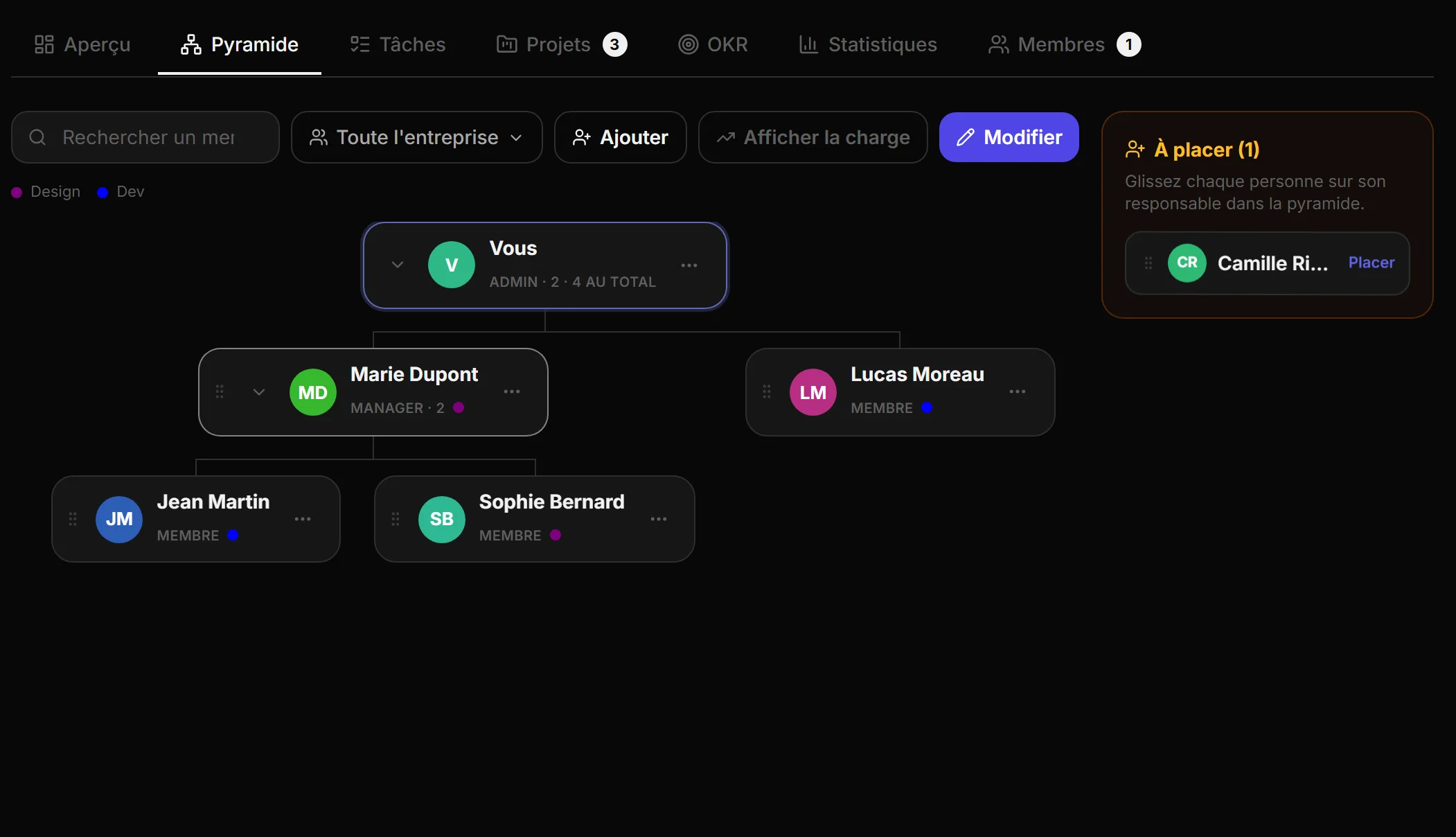
Everyone joins the organisation with the Cosmo account they already have, by organisation code or by single-use link, and you attach them to their manager. You then create as many teams as you need and place whoever you want in them, and one person can belong to several teams. Access follows from that single attachment: a manager sees their complete subtree (their teams, their projects, their goals, their statistics) without a single permission having to be ticked by hand. Changing an attachment is enough to reorganise, because rights are not copied anywhere: they are recomputed from the link.
The org chart is not a staff directory, it is the screen from which you follow each person: opening their card shows their current tasks, their load and their schedule. A manager can create, move and edit calendar events for the people who report to them; what those people have marked as personal stays private, and only the slot appears. Two sibling branches of the org chart, on the other hand, are partitioned, and the rule is enforced in the database, not merely hidden in the interface.
Step 2: create your projects and assign them at the right scale
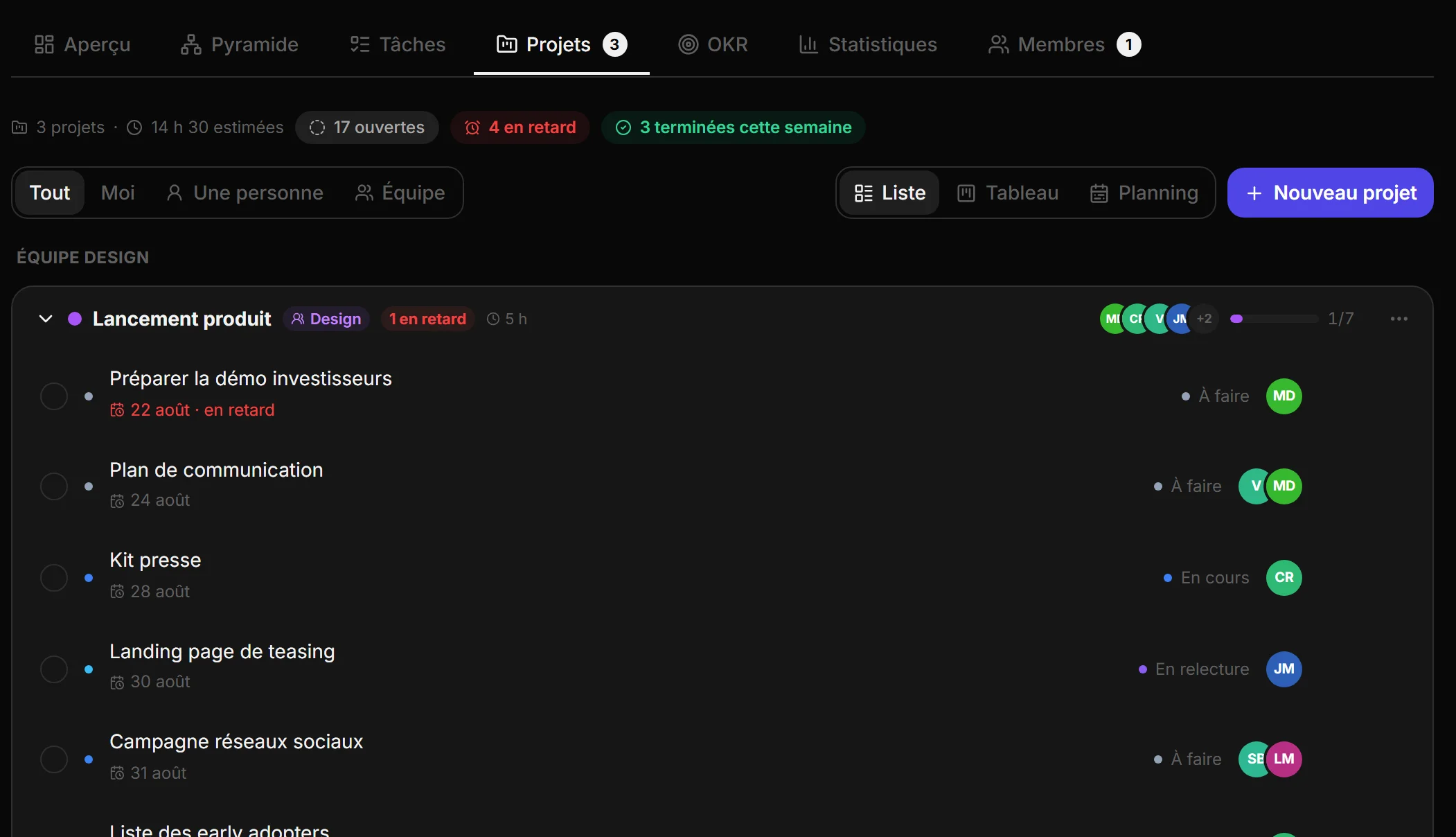
A project belongs to a team and gathers its tasks. You assign them to one person or several, anywhere in your scope, and each of them finds those tasks in their own Cosmo alongside their personal ones. A kanban to know where each task stands, a timeline to see deadlines coming, with subtasks, labels, comments with mentions and a change history.
Step 3: set your goals, at every scale
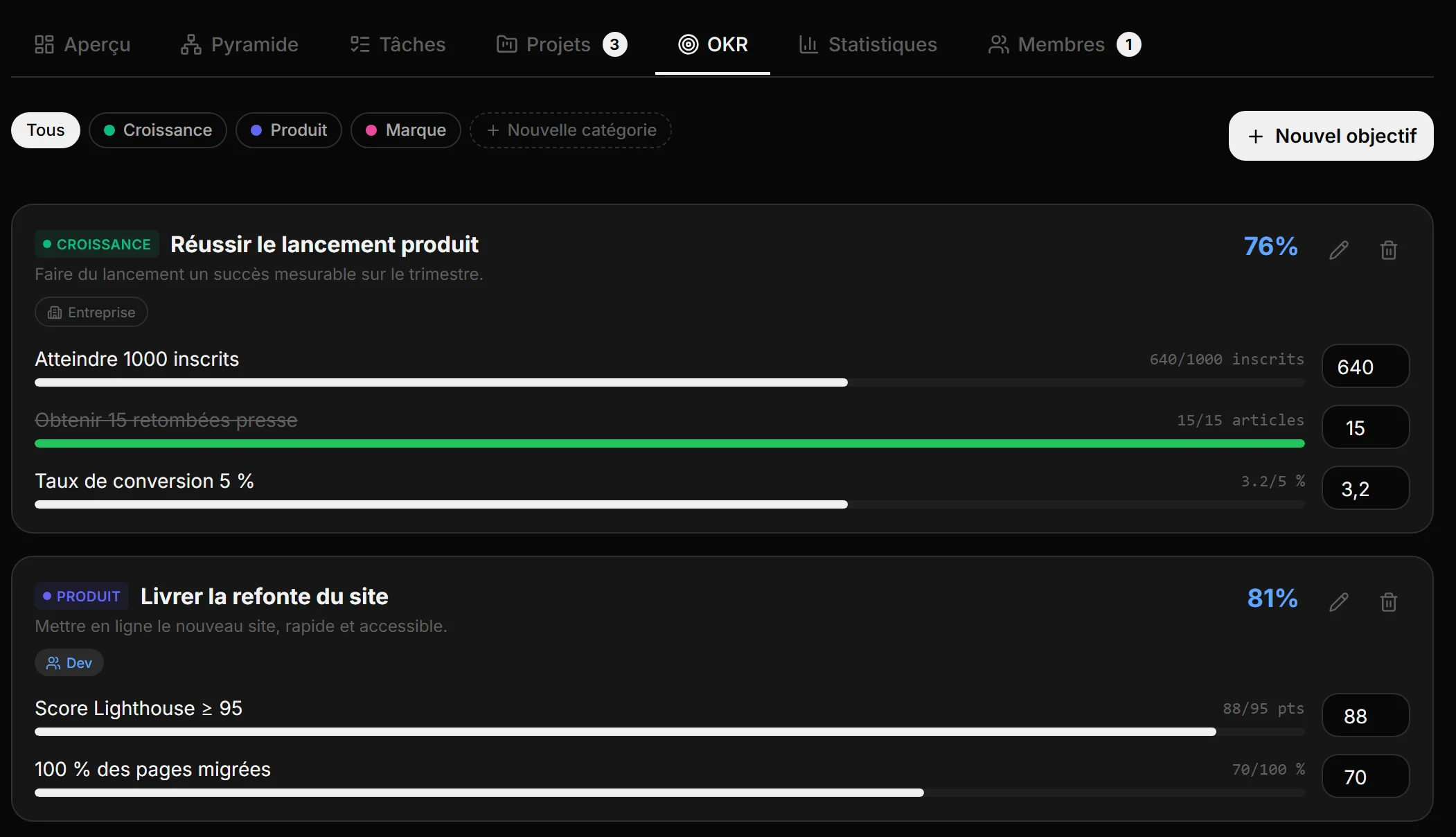
An organisation goal cascades into team OKRs, each OKR into numeric key results: the same mechanism at every level, in the categories you define. Each key result achieved is logged on the date it was achieved, in a journal that cannot be rewritten afterwards, and that is what makes the dashboard curve defensible in a steering committee.
Step 4: follow everyone's progress
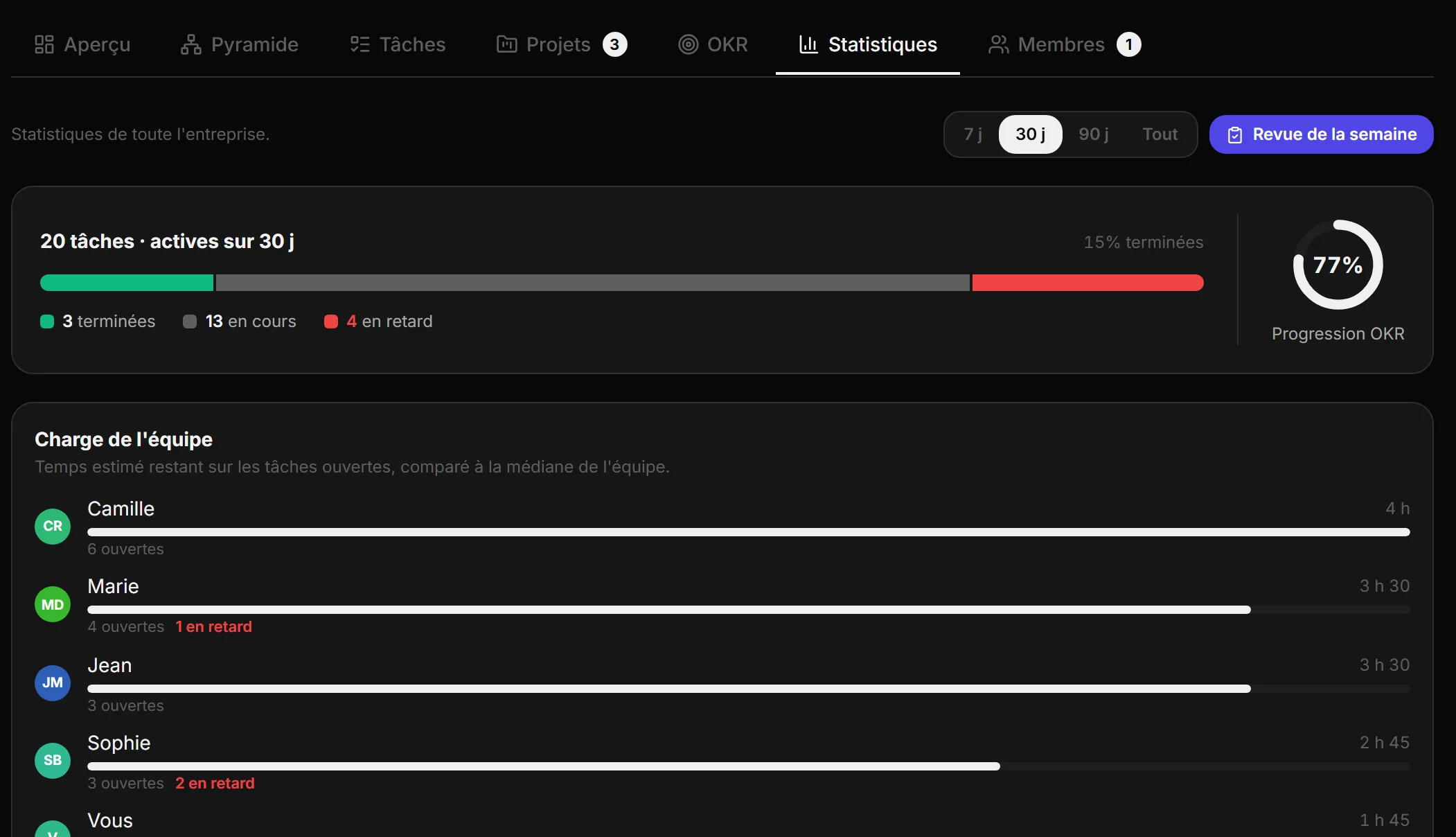
The Statistics tab answers the Monday morning question: who is moving, who is falling behind, who is overloaded. Velocity and trend over the period compared with previous ones, open tasks and delays for each member, time invested aggregated by team and by project. Leadership reads the whole organisation, a manager reads their scope, and the attachment set up in step 1 is what decides that. The overview, meanwhile, opens each day: your assigned tasks, your deadlines and what has just moved in your teams.
Security, privacy and reversibility
Every table is protected by access policies evaluated server side: a request forged from the browser brings back nothing more than a legitimate one. A manager sees the work in their scope, never the personal tasks, habits or calendar of their colleagues. Account deletion is genuinely executed server side, consent to joining an organisation is explicit, and no data is resold. Transferring ownership and deleting the organisation are in the interface, not in a support ticket.
Pricing
One plan for the whole organisation, whatever the number of projects, rather than a per-person price: free up to 5 members, 20 € a month from 5 to 10 members, 50 € from 10 to 20, 100 € from 20 to 50, and 200 € beyond 50. The plan adjusts itself as the organisation grows and comes back down if headcount falls. No commitment, cancellable at any time, no credit card to start.
Cosmo for me · Create my organisation · User guide
User guide · Cosmo for companies · Blog · For freelancers · For students · For managers · For teams · About · Free sign-up · Sign in · Legal notice · Privacy · Terms · contact@thecosmo.app